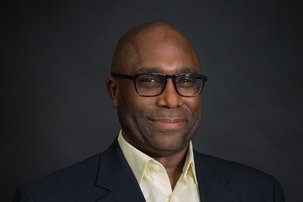
A Visionary in Public Health and Black Queer Advocacy: The Louis Graham Virtual Roundtable
To Charles Stephens, Dr. Louis Graham was a socially conscious collaborator and intellectual sparring partner who pushed him to create a nonprofit centered on Black queer men. To public health professor Dr. Robert Aronson (Bob), Graham was a determined scholar who proved the ivory-tower institutionalists who doubted his brilliance wrong. To Dr. William Lopez (Bill), a population-health researcher, Graham was a generous colleague who embraced the humanity of the marginalized people and communities he studied, rather than simply observing them as subjects.
All three men agreed on one thing: Graham was one of a kind, an exceptional researcher and prescient intellectual who altered their lives and changed their perspectives. He blazed a brilliant trail across the public health research and academic landscape before age 40, determined to use his knowledge to help those whom society often overlooks.
“Initial impressions: this guy is young,” said Aronson, director of the public health academic program and lecturer at Elizabethtown College in central Pennsylvania. “This guy is incredibly bright. He thinks very deeply about things.”
Aronson’s recollection came during a roundtable discussion on the work and legacy of Graham, an LGBTQ community activist, a University of Massachusetts-Amherst professor, and a public health scholar. A Morehouse School of Medicine (MSM) alumnus, Graham died suddenly in December 2019.
Hosted by MSM and the Counter Narrative Project (CNP) — an organization centered on Black LGBTQ+ communities, racial justice, and HIV advocacy — the discussion focused on Graham’s many contributions to public health and on his career as a model for aspiring scholars, researchers, policy advocates, and practitioners.
Along with Stephens, CNP’s founder and executive director, the panel included Aronson and Lopez, a researcher and assistant professor at the University of Michigan. Lopez is also senior advisor in Michigan’s Poverty Solutions think tank and a faculty associate in the school’s Latino Studies program.
All three got to know Graham through different facets of his career. Stephens partnered with him in Atlanta on Graham’s research projects on the mental health of Black gay men when Graham pursued a master’s degree at Morehouse School of Medicine, while Aronson — then a faculty member at the University of North Carolina-Greensboro — was Graham’s faculty advisor when Graham studied for his doctorate there. Lopez worked closely with Graham when both were postdoctoral fellows at Michigan’s School of Public Health.
Each said Graham was a singular talent, possessing a rare combination of intellect, curiosity and an innate understanding of his subjects. His research, they say, took place at the intersection of physical and mental health, socioeconomic status, race and sexuality, staking a claim to territory few researchers have studied in depth.
Graham “had a strong interest in issues related to mental health, especially with Black men, [and] sexual minority men,” Aronson said. Graham, he said, believed “it was all connected” — unhealthy choices, poor health outcomes and chronic diseases among gay Black men are rooted in depression and anxiety triggered by racism and marginalization — but no one in the predominantly white academia had firmly established the connection.
At the same time, Graham “wasn't just about collecting data and analyzing and getting manuscripts out,” said Aronson. “He was always interested in understanding the context of people's lives and how it impacts them.”
Lopez said that often meant Graham immersed himself in community-based participatory research, or CBPR — an academic approach that emphasizes on-the-ground connections between researchers and community members. Graham, he said, was a natural, and deployed his own techniques in using the concept.
In Detroit, “we would hang out at the park and hang out with people” and sometimes shoot hoops with them, Lopez said. “We spent so much time just in many of the spaces in which research participants were also frequenting. And I didn't realize until much later that that wasn't typical of CBPR.”
Rather than observe or only talk with community leaders, Lopez said, “Graham’s model was more like, ‘Who is the person who's least likely to end up in this room and at this table? Who are the groups of people who might be missed in this particular conversation?’ That's where he would form his ideas.”
Those ideas, Lopez said, usually led to Graham’s singular goal: “He just really lived his life like he wanted to make the world better, and he used whatever tools he had to do that.”
Stephens said Graham’s desire — leave communities better off than he found them — led him to see things other researchers didn't, including ties between race, queerness, and mental and physical health.
“I was this little Black boy reading [French philosopher Michel] Foucault. And I was like, ‘Oh, you're doing public health? I read ‘Discipline & Punish,’” Stephens said, noting he was initially dismissive of his new friend’s zeal for public health. “Eventually, we had this kind of mind meld” in which Graham convinced Stephens their interests aligned.
Stephens began to help Graham conduct research, while Graham inspired Stephens to launch the Counter Narrative Project. In his published works, Graham always credited Stephens, yet Graham demurred when Stephens wanted to credit him as a CNP co-founder.
“Louis's great contribution to my life was just the importance of how we measure and how we assess mental health,” particularly among Black people, Stephens said. “He was arguing 15 years ago that part of why Black [people], particularly Black gay men, are not [regularly] assessed as being depressed or having anxieties is because the tools we use to measure it are [culturally] flawed.”
Aronson noted Graham pulled together a group of Black queer men who were mental health professionals and worked with them to adapt assessment tools and make them culturally relevant. That effort and other work on his doctoral dissertation, he said, opened the eyes of fellow academics who didn’t believe Graham had what it took to earn his doctorate.
It was “an incredible and ambitious dissertation, and he did a fabulous job,” Aronson says. “There were plenty of doubters out there. [At year’s end] I went off on people who did not believe this guy could do it, and he was probably the best student they ever turned out.”
Stephens, Aronson and Lopez all agreed that Graham was as good a friend as he was a colleague: generous, thoughtful and insightful.
Had he lived on, “I know he would have been cutting edge of lots of things,” Lopez said, adding that he misses Graham constantly. Aronson agreed: “His impact was simultaneously personal and professional. He was a genuine human being and an incredible thinker.”
Stephens, meanwhile, said he grew professionally because of Graham, and “iron sharpens iron.” He recalled a series of upbeat meetings he and Graham had with philanthropic organizations just ahead of CNP’s launch; it felt like “the wind was at our backs.”
Then, he said, Graham suddenly died — a devastating loss.
“Destiny can be so cruel sometimes,” he said. “Right when we got to the point where we were ready to take off, I guess destiny had something else in mind.”
Dr. Louis Graham Obituary
From Dr. Graham’s memorial service. Service held on January 25, 2020 at the Progressive Community Baptist Church, Springfield, Massachusetts.
Dr. Louis Graham
Louis Graham, DrPH, an assistant professor in the Department of Health Promotion and Policy at UMass Amherst from 2013-2018, passed away suddenly on December 29, 2019. Dr. Graham received his BA from Carleton College, his MPH from Morehouse School of Medicine, and his DrPH from the University of North Carolina-Greensboro. Dr. Graham was an intellectual, a deep and innovative thinker, and a cherished colleague. His research addressed the health effects of marginality, including racism, homophobia and sexual minority discrimination. He was the Principal Investigator of a large grant funded by the National Institute of Minority Health & Health Disparities, investigating chronic disease prevention with the Men of Color Health Awareness (MOCHA) program in Springfield, MA. This community-based participatory research project focused on stress and resilience among low-income African-American men. His legacy will live on in the Stories Matter curriculum he developed with MOCHA and that is touching the lives of so many black men. Dr. Graham was also a central figure in establishing the UMass Amherst Center for Community Health Equity Research, whose intersectional approach reflects his commitment to understanding the complex nature of oppression and the need to address multiple forms of inequality at once. His insights and provocative contributions pushed his colleagues and friends to think more deeply about their lives, work and actions. His scholarship was nationally recognized by the Harold Dean Philpot Leadership Award for Excellence in National AIDS Education and Services for Minorities (2011), which he received while he was a W.K. Kellogg Health Scholars Program Postdoctoral Fellow (2010-2012). Through his successful community partnerships and mentorship, Dr. Graham’s work has made a measurable difference in the lives and futures of many. His loss is a tremendous blow to the fields of community health education, community-based participatory research, and to research on structurally-rooted health inequity.