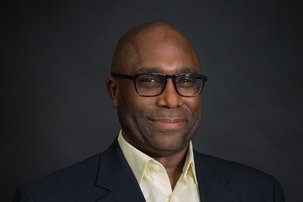
“A Boss” and Champion for Health Equity and Marginalized Voices: The Louis Graham Virtual Roundtable
As a public health researcher, the late Louis Graham was a gifted, outside-the-box thinker dedicated to centering Black, queer, and other marginalized communities. As a scholar and health policy advocate, he was brilliant and creative, able to impress the Centers for Disease Control and Prevention, often regarded as the gold standard public health organization.
As a friend, those who knew him recalled, Graham was warm, generous — and fearless.
“I remember one time, he was in a barber shop,” says Charles Stephens, a friend and one of Graham’s frequent collaborators. “I mean, if you're in a barber shop, you might hear some homophobia, right? And you make your choices. This one — he was in Greensboro, and somebody said something real homophobic.”
Graham didn’t miss a beat: “Louis — mid haircut — hopped out the chair and ripped the apron off and went off” on the homophobic barber, Stephens says. “Then he went on his way.” With an unfinished haircut.
“Louis was brilliant,” says Stephens, the executive director and founder of Counter Narrative Project, an Atlanta nonprofit. “He was amazing, but he was one of the toughest, toughest people I've ever known.”
Stephens’ recollection came during a roundtable discussion on the legacy of Graham, an activist, University of Massachusetts-Amherst professor and Morehouse School of Medicine (MSM) alumnus, who died suddenly in December 2019.
Hosted by Stephens, the roundtable is a partnership between MSM and the Counter Narrative Project — an organization whose mission includes narrative change about Black LGBTQ+ communities, racial justice, and HIV advocacy — and the discussion focused on Graham’s many contributions to public health and on his career as a model for aspiring scholars, researchers, policy advocates and practitioners.
Along with Stephens, the panel included Dr. Kisha Braithwaite, professor of psychiatry at Morehouse School of Medicine, and Dr. Ugo Edu, assistant professor of African American studies and medical anthropology at the University of California-Los Angeles.
All three were Graham’s friends and colleagues; their nexus was Atlanta, where Stephens’ organization is based. Braithwaite, Edu, and Graham all have ties to MSM: Braithwaite is a researcher and faculty member, while Graham and Edu were both graduate students working on master’s degrees in public health.
The panelists all pinpointed Graham’s intellect as the first thing they noticed when they first met. When they partnered on a research project, Stephens noticed that Graham had a gift for breaking down public health concepts into language the community could understand.
Disseminating information to the public “is something that he always had a lens for,” Stephens says. “It's not enough to collect data, it's not enough to do this research” if it never reaches the people it’s intended to help.
Edu agreed, noting she and Graham co-created a newsletter for the community.
“Sometimes within academia, within our respective fields, we don't hold ourselves accountable in the ways that might matter,” Edu says. Graham, she says, believed it was “important to get that information out, but also allow the community to speak back to us and say, ‘Yeah, you didn't get this right.’”
Braithwaite said he was her go-to intern at the Satcher Health Leadership Institute, a great communicator who “could just jump right in” without much hand-holding or self-doubt.
“He was very innovative in the way he thought about and put together public health concepts,” she says. “The whole vision of Morehouse School of Medicine is leading the creation and advancement of health equity, whether it be through education or clinical care community-based programs. I felt comfortable all the time actually having Louis go out and represent us. He definitely set the standard of excellence for any intern that came subsequently.”
Stephens described Graham as a brilliant thinker who didn't confine his intellectual prowess to the lab or the classroom. He recalled a debate they once had about whether “black queer men were disproportionately impacted by depression and anxiety.”
Graham argued they were, but there wasn’t data on it “because the tools that were developed to measure those things are not culturally tailored, so they don't pick it up.” The point, Stephens said, floored him: “I didn't even know that anxiety was [an issue]. He just had these really bold and innovative and disruptive [concepts]” that are relevant “even to this day.”
As a classmate, Edu says, Graham was curious and intrepid: “He didn't take something just as it was. He was good at taking it and saying, ‘Well, let me, let me dig a little deeper, let me peel this back, let me ask some questions here.’”
For example, “I remember we talked about this increase of Black youth in the South hanging themselves and committing suicide,” she says. “And he was, like, ‘What do we think about this? Very often, it's just Black people in the South — they're just having more depression, anxiety, and they're killing themselves. But what's actually really happening? What are we not talking about?’”
Asked what MSM students could learn from Graham, Braithwaite pointed to Graham’s work ethic (“He didn’t cut corners”) and perseverance. But she identified another of his superpowers: an ability to “connect with people and make [them] feel comfortable enough to even share and open up enough about certain topics.”
As a researcher collecting data, it’s easy to go into a community, collect data and leave, she says; what’s harder is “to really take the time necessary to recognize that there is a way that you can build a relationship with the target community,” she says. “And that's certainly what Louis did.
Amen, says Edu: “When you read his work, don't just read it and grab the diagram or the model or the theory or the framework,” she says. “Really engage [with] his work, because I think there's, there's so much more there that we can learn than [just] around process,” such as relationship-building and care,
That commitment, care and dedication, Edu says, shined through during Graham’s not-so-great encounter with the loudmouthed Greensboro barber, Edu says.
“Even the care of telling someone off, like, ‘What we're NOT going to do is be homophobic in this space’” is revealing, she says. “That care and the collaborative work, and paying attention to those stories that are not told, that are not making it to the mainstream — those are some things [Graham exemplified] that I feel like would be essential for students. And I think again, just echoing Keisha in terms of excellence.”
Lewis, Edu says, “was a boss.”
Dr. Louis Graham Obituary
From Dr. Graham’s memorial service. Service held on January 25, 2020 at the Progressive Community Baptist Church, Springfield, Massachusetts.
Dr. Louis Graham
Louis Graham, DrPH, an assistant professor in the Department of Health Promotion and Policy at UMass Amherst from 2013-2018, passed away suddenly on December 29, 2019. Dr. Graham received his BA from Carleton College, his MPH from Morehouse School of Medicine, and his DrPH from the University of North Carolina-Greensboro. Dr. Graham was an intellectual, a deep and innovative thinker, and a cherished colleague. His research addressed the health effects of marginality, including racism, homophobia and sexual minority discrimination. He was the Principal Investigator of a large grant funded by the National Institute of Minority Health & Health Disparities, investigating chronic disease prevention with the Men of Color Health Awareness (MOCHA) program in Springfield, MA. This community-based participatory research project focused on stress and resilience among low-income African-American men. His legacy will live on in the Stories Matter curriculum he developed with MOCHA and that is touching the lives of so many black men. Dr. Graham was also a central figure in establishing the UMass Amherst Center for Community Health Equity Research, whose intersectional approach reflects his commitment to understanding the complex nature of oppression and the need to address multiple forms of inequality at once. His insights and provocative contributions pushed his colleagues and friends to think more deeply about their lives, work and actions. His scholarship was nationally recognized by the Harold Dean Philpot Leadership Award for Excellence in National AIDS Education and Services for Minorities (2011), which he received while he was a W.K. Kellogg Health Scholars Program Postdoctoral Fellow (2010-2012). Through his successful community partnerships and mentorship, Dr. Graham’s work has made a measurable difference in the lives and futures of many. His loss is a tremendous blow to the fields of community health education, community-based participatory research, and to research on structurally-rooted health inequity.